Sylvia leaves Patrick
Dark Lies the IslandSilvija’s departure from Patrick is a quiet, decisive break: she packs the holdall that has travelled with her, leaves their shared studio, and tells him that he must find a life of his own. Patrick answers with anger, then depression and departure from Berlin; six years later, he has neither received a reply to his emails nor reached her by phone. The ending offers no confirmed reunion or definitive explanation. Instead, Patrick preserves a photograph and sustains the belief that Silvija is still somewhere among Europe’s cities, beyond his reach but not erased from his imagination.
The breakup in the studio
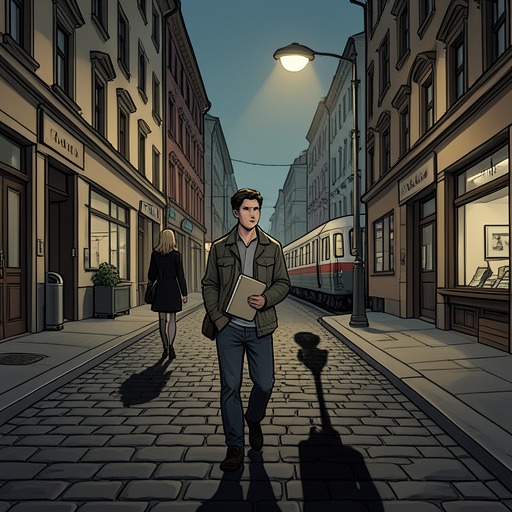
The end comes sharply, as Patrick puts it: one morning he wakes to find Silvija packing. The familiar holdall has already seen plenty, a detail that gives the departure the weight of a life in motion rather than a carefully staged farewell. Patrick tries to sound casual, but recognises fear in his own voice as he asks whether this is really it.
Silvija replies that he knew it was coming. She says the studio has had its time and that she will stay with a girlfriend in Kreuzberg. Her stated reason is not a sudden quarrel: the arrangement has run its course, and Patrick needs to stand on his own two feet. Her instruction that he find his own life makes the separation a demand for independence as well as a departure from their shared home.
Patrick’s reaction and departure
Patrick’s first response is defensive anger. He tells Silvija to see a doctor, but his account makes clear that the insult covers the injury of being cast aside: he is lost in the city without her and becomes depressed. He stays for a while with other people in Mitte, artists whom he remembers only as seeming to act parts beside Silvija. His comparison shows how thoroughly she remains the measure against which he experiences the people around him.
Patrick comes to feel that the sweet days of summer have passed and that it is time to fly away. Silvija reluctantly accompanies him to the station on the morning he leaves for the airport. She hugs him on the platform, but the embrace is awkward and she flees from it at once. The small, physical exchange gives their separation a final shape: contact occurs, but neither the hug nor the promise to stay in touch restores their former closeness.
The silence after Berlin
Silvija says she will email and that Patrick can phone. In the six years that follow, however, she never replies to an email or answers a call; after a few months, the phone line is dead. Patrick immediately qualifies what these facts might mean. They signify nothing necessarily, he says, because Silvija changed phones all the time. His qualification prevents silence from becoming conclusive proof of rejection, while leaving the loss itself untouched.
The ending therefore remains unresolved rather than explaining why Silvija stops responding. Patrick must live with both the observable absence and the possibility that it has another explanation. His belief that she is still out there somewhere among the dreaming cities of Europe—perhaps in Trieste, Zagreb, or Belgrade—keeps her life beyond the frame of his account. He insists on remembering her as beautiful, foul-mouthed, and inviolate: an image that preserves her distinctness even as their relationship becomes inaccessible.
Memory and the shape of the ending
The departure is narrated retrospectively by Patrick, who looks back not only on the breakup but on the years of unanswered attempts that followed it. His account moves from the sudden sight of the packed holdall, through his departure from Berlin, to six years of silence and an imagined geography of possible destinations. The sequence records what happened while refusing the comfort of a final explanation.
A photograph remains sacred to Patrick. In it, Silvija is reflected in the amber of a stein glass, her camera raised; she is blurred, only a shade, but it is all he has left of her. That image makes the limits of his remembrance concrete: he can retain a trace, not recover the person or reopen the relationship. His insistence that Silvija must still exist somewhere in Europe holds hope beside that loss without resolving either one. The break’s significance lies in this enduring separation between what Patrick can preserve—a photograph, a remembered voice, a set of possible cities—and what he cannot regain: Silvija’s presence or response.